


Foundation WomanUp Takes Part in an International Erasmus+ Training for Young Parents

Career or caregiving-up? Women shouldn't have to choose
From August 25-30, 2026 in Jelgava, Latvia, Foundation WomanUp took part in an international training via Erasmus+ focused on the professional challenges women face when they are parents. Motherhood might come as an obstacle in the pursuit of international professional engagements due to the constant expectations towards women to be always available for caregiving. The topic is new and untackled within the Erasmus+ field and thanks to Biedriba.Idea Foundation in Latvia, WomanUp together with several other organisations from Poland, Italy and Hungary brought up the subject more widely. We gained valuable knowledge about what the problems are and what could be possible solutions. A lot of questions arised but a lot were also answered.
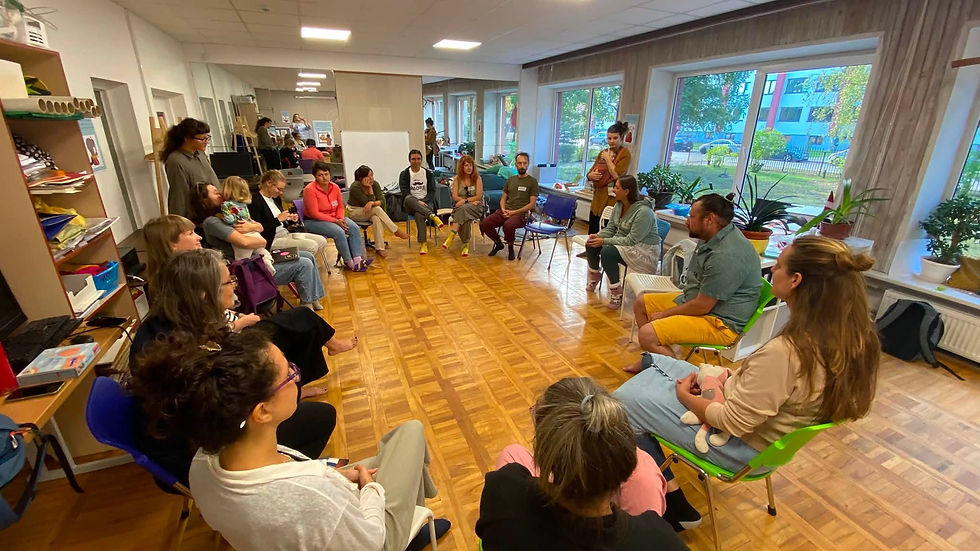
As an organization that works actively towards protecting the rights of women in Bulgaria in all sectors of professional and public life, including motherhood, reproductive rights and healthcare, Foundation WomanUp supports initiatives that address challenges faced by young professional mothers on the path of their career development. The training helped our members to enhace their knowledge on the subject and gain new insights on how the issue could be resolved. We are looking forward to spreading this knowledge in Bulgaria and raising awareness about the topic.
The discussion introduced a socio-ecological way of examining what it means to be both a parent and a professional, working in the Erasmus+ environment. Participants were invited to move beyond seeing their difficulties as purely personal and to identify how their experiences are shaped by relationships, organisations, programme rules, policy, and wider cultural expectations.
The purpose of the training was to collect real experiences, including feelings, barriers, injustices and successful support arrangements, and to use them to build stronger arguments for a change. The group worked at several levels, beginning with the individual level before later considering interpersonal support, organisational practice, programme and policy systems, and wider social and cultural norms.

The discussion centred on the realities of being both a parent/caregiver and a professional in the Erasmus+ youth-work field. Participants explore why international mobility, training work and project participation can become much harder after having children—not simply because of personal choices or poor planning, but because of interconnected family, organisational, financial, cultural and programme-level barriers.
A central idea is that parenthood should be understood as a temporary life-stage need that requires flexibility and support. We repeatedly challenged the assumption that caregiving is a private matter which professionals should solve alone. They argue that Erasmus+, and the organisations working within it, risk losing experienced trainers, facilitators and youth workers when systems assume constant availability, unrestricted travel, late working hours and the ability to accept opportunities at short notice.
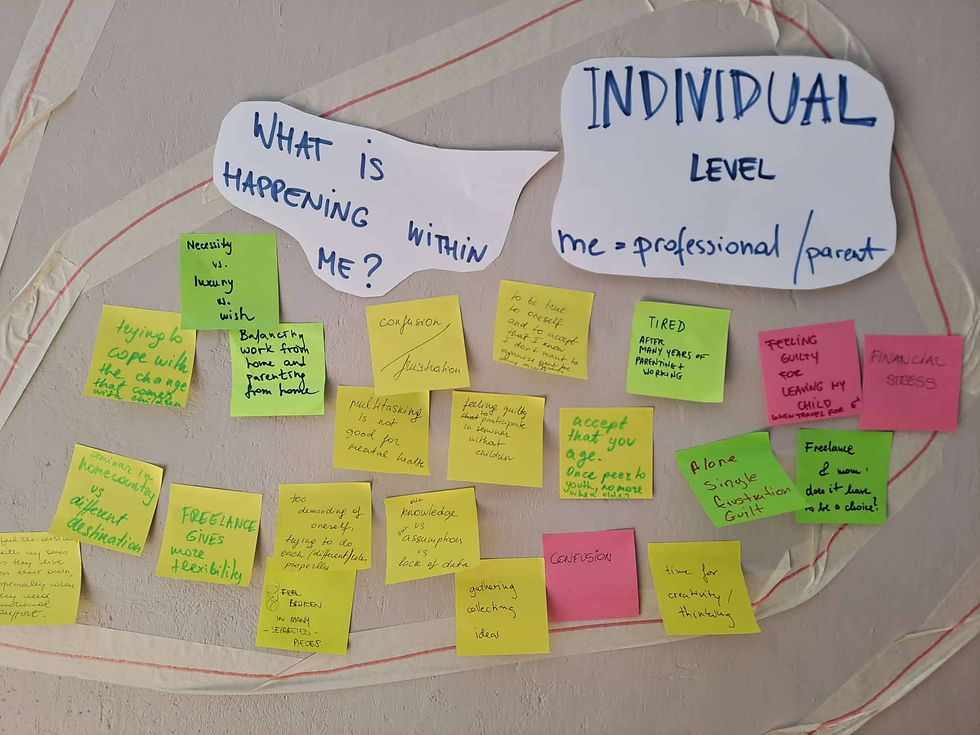

The discussion also highlighted that being a parent can be isolating, especially for young parents whose friends may still be focused on study, nightlife or other life stages. At the same time, returning to work can be deeply important: participants describe missing adult conversation, professional identity and meaningful work during periods of intensive childcare. Parenthood is not described only as a burden; people also value family life, enjoy caring for their children and find that parenting can enrich their understanding and work. The issue is not that parents should choose work over family, but that they should not have to leave the field in order to have a family.
A central theme was that parents—particularly mothers—are often expected to remain fully available, productive and professionally reliable while also carrying most childcare and household responsibilities. When these expectations cannot be met, the issue is often treated as an individual parent’s problem rather than as a structural barrier within professional life and Erasmus+ activities.
Participants discussed how deeply rooted beliefs about motherhood, fatherhood and professional commitment affect parents’ choices. One recurring example was the expectation that a mother, rather than a father, will respond when a child cries or needs care—even when both parents are present. The group described this not simply as an individual family arrangement, but as part of a broader social assumption about who is responsible for care.
Many participants felt that mothers are judged more harshly than fathers when travelling for work. A mother who needs to travel may be criticised for leaving her child, while fathers may be praised for caregiving but are still less often assumed to be the main caregiver. Online parenting spaces were described as particularly judgmental: mothers may ask for practical advice, such as how to find a babysitter for a work trip, and receive criticism that they should stay at home instead.


The discussion also questioned narrow ideas of productivity. Participants noted that people may be perceived as less productive, less reliable or less professional after becoming parents. One speaker referred to changes after giving birth and asked whether it could be acceptable for a parent to be operating at “sixty percent” for a period while still bringing valuable experience and skills to their work. The group stressed that productivity is difficult to measure in youth work and training, where care, emotional presence, relationships, values and meaningful engagement matter as much as visible outputs.
Overall, it could be concluded that parenthood should not be tackled as a personal obstacle only or an issue that concerns only women but more of a societal phenomenon. In today's world the challenges of parenhood should be addressed more as a common experience that everyone goes through rather than an individual matter to be tackled in private.
It's worth considering the imporatnce of community when raising a child and how modern society has moved away from its support and availability. Mother circles, peer support, emotional first aid from other mothers, and a mothers’ choir that allows women to meet and and take part in cultural and wellbeing activities while children are present. These examples show both the value and the difficulty of creating supportive spaces: they require trust, continuity and practical energy.

Co-funded by the European Union. Views and opinions expressed are however those of the author(s) only and do not necessarily reflect those of the European Union, European Commission or the granting authority (Agency for International Programs for Youth). Neither the European Union nor the granting authority can be held responsible for them.


Comments