


What is the face of feminism for young women today? AGORA 2026

What is the face of feminism for young women today? Who are today's feminist leaders and what do they learn from each other?
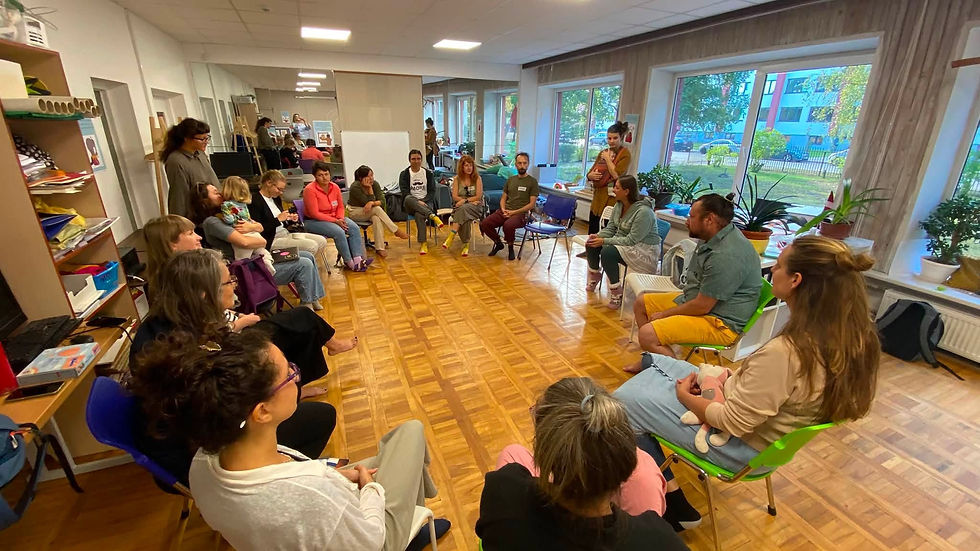
We discussed this and many other topics between 7-11 September, 2026 at AGORA Young Feminist Summer Camp in Brussels, Belgium.
One of our co-founders, Maya Geneva, together with two Bulgarian trainers - Shirin Hozdheva and Margarita Spasova, and the organizer - Maya Doneva - were the representatives of the Bulgarian delegation during the training.
Maya held a seminar on women's rights during pregnancy and childbirth - a topic largely painful throughout Europe and even more so in Bulgaria. According to the results of a nationwide research WomanUp Foundation conducts regularly amongst women who have given birth, it has become clear that women are not aware of their rights such as: saying "no" when something does not feel right; being informed about medical procedures; the right to informed consent; discussing a birth plan and demanding its completion; proper communication and connection with the medical team. And many more. AGORA 2026 was a chance to reveal the research findings and shed more light on the situation both in Bulgaria and in Europe.

As a Foundation that works for the protection of women's rights in all walks of life, with special focus on reproduction, pregnancy and maternity rights, it is of key importance for WomanUp to attend international trainings, gain new knowledge and exchange experience with foreign partners from other organisations.
Within 5 consecutive days we discussed a variety of topics and issues - from consent education and the digital space to reproductive justice and gender based sexual violence. We also covered workshops on forced displacements; access to protection, psychological first aid.

Consent Education: A Powerful Tool to Prevent VAWG - by Aimee Wallace
The workshop explored consent education, examples from the speaker's personal experience facilitating & campaigning, and allowed participants to share their experiences of consent education and what changes they would like to see being made.
From invisible Barriers to Policy - Translating Feminist Research into Policy that Sticks - by Michelle Perino & Sofia Menghini
The feminist movement generates excellent research. But it consistently fails to convert that research into durable institutional change. Using a case study on gendered emotional norms in European Parliament debates, this session explored how evidence on invisible barriers can be translated into policy responses.
Reclaiming our digital space: combating the rise of online gender-based violence - by Andreia Almeida & Onitina Iavotriniaina
The purpose of this workshop was to improve the understanding of online-gender based violence and discussed ways to combat it at different levels. We explored the role of platforms and algorithms on promoting a roll back against gender equality. Participants evaluated the effectiveness of current tech and legal safeguards and worked collaboratively to design strategies for change.
Code Red: Why menstrual health education is a global health issue. A closer look at Ghana and Poland - by Julia Mikolajczyk & Nana Ama Abedi
Every month, there are approximately 1.8 billion people worldwide who menstruate. Menstruation, which is a natural phenomenon, is still surrounded by stigma and taboo, making it an almost forbidden or frowned-upon topic in public discourse.
In Ghana, about 31% of girls have not received any form of menstrual education, and about 2 million still lack access to basic toilet facilities. In Poland, 35% of surveyed girls by the Kulczyk Foundation in 2020 reported not having discussed menstruation until after menarche. The objective of the workshop was to provide tools to help young girls advocate for their bodily autonomy through a better understanding of menstruation.
Reproductive justice and gender-based violence against pregnant women - by Maya Geneva & Manuela Haug
The first part explored narratives around reproductive justice, including its meaning and historical evolution. It will be facilitated by Manuela, drawing on her experience as an activist in the pro-choice movement.
The second part focused on institutional and obstetric violence within healthcare systems, with particular emphasis on the experiences of pregnant and birthing women. This session was facilitated by WomanUp's founder - Maya Geneva.

Psychological First Aid for Women in Crisis & Care as Feminist Practice - by Ella Yar & Emma Gaš
This interactive workshop explores how psychological first aid and feminist care practices can support women experiencing crisis. Participants will gain practical tools, reflect on trauma-informed and feminist approaches to care, and discuss how these perspectives can be applied in real-life settings to promote safety, empowerment, and resilience.
Attending AGORA Young Feminist Summer Camp 2026 helped us gain a deeper understanding on the current development of feminist issues and where different countries stand in their work. This was a valuable knowledge and experience that will help us improve our own local work and transfer what we know to all women who need it.
Comments